
Resources > CVSA English Proficiency Regulation Update 2026
CVSA English Proficiency Rules 2026 Update: Now Federal Law
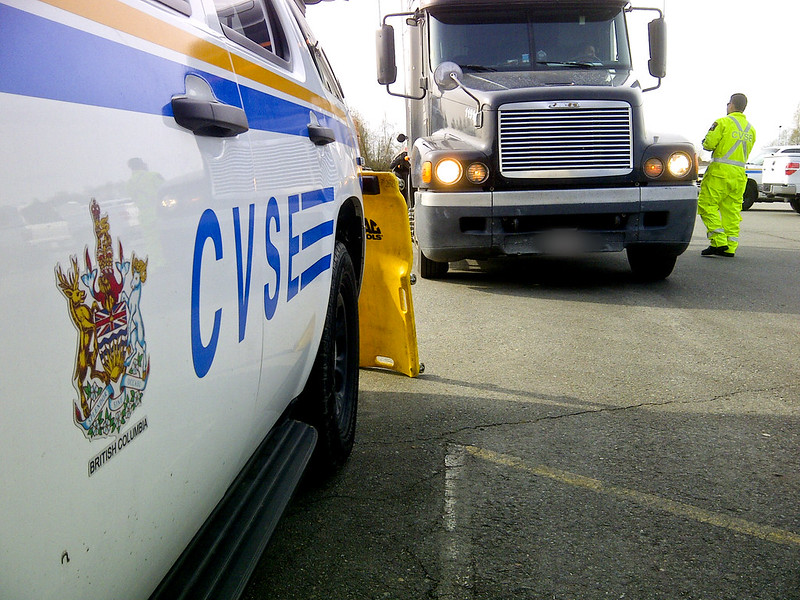
Credit: Flickr
Takeaways
- English Language Proficiency (ELP) violations have been an out-of-service condition since June 25, 2025 and as of February 2026, Congress made it federal law.
- Operation SafeDRIVE in January 2026 placed nearly 500 drivers out of service for ELP violations alone in just three days across 26 states.
- FMCSA has formally clarified the two-step inspection process and the U.S.-Mexico border zone exemption.
- The CVSA Out-of-Service Criteria handbook was updated April 1, 2026. The rule is now fully codified in print.
- Carriers are responsible for verifying ELP compliance in driver qualification files.
- A related Non-Domiciled CDL Final Rule took effect March 16, 2026, tightening the broader driver qualification landscape further.
Table of Contents:
Introduction
When we first published this article in June 2025, the English Language Proficiency (ELP) rule was a new enforcement reality. It was significant, but still early days. CVSA had just added it to the out-of-service criteria, inspectors were beginning to enforce it, and the industry was still absorbing what it all meant.
A lot has changed since then.
What began as an executive order and an enforcement policy directive is now federal law. Congress codified the ELP out-of-service requirement in February 2026. The CVSA’s official Out-of-Service Criteria handbook was updated in April 2026 to formally include it in print. And a January 2026 enforcement operation across 26 states placed nearly 500 drivers out of service for ELP violations in just three days, making it one of the most actively enforced driver qualification standards in the country right now.
If your fleet hasn’t updated its driver qualification process to reflect these changes, use this article as a guide.
Recap: CVSA English Proficiency Rules on June 25, 2025
For context, here’s what the original rule change established:
The underlying regulation (49 CFR § 391.11(b)(2)) has existed for decades. It requires all commercial motor vehicle drivers operating in the U.S. to read and speak English sufficiently to converse with the general public, understand highway traffic signs and signals, respond to official inquiries, and make entries on reports and records.
For nearly a decade, this regulation sat dormant. A 2016 FMCSA memo had directed inspectors not to place drivers out of service for ELP violations, effectively suspending enforcement. That changed on April 28, 2025, when President Trump signed an executive order directing FMCSA to reinstate full enforcement. Transportation Secretary Sean Duffy followed with a formal directive, and CVSA added ELP to its North American Standard Out-of-Service Criteria, effective June 25, 2025.
From that date, any driver who fails an ELP assessment during a roadside inspection can be placed out of service immediately.
Updates: Major Developments Since June 2025
Congress Made It Federal Law
February 2026
This is the most significant development since the original rule change. On February 3, 2026, the U.S. House passed the Consolidated Appropriations Act of 2026, signed into law by President Trump. The Act contains a provision requiring FMCSA to update regulations to require that non-compliance with 49 CFR 391.11(b)(2) triggers an out-of-service order.
What this means practically: ELP enforcement is no longer just a policy directive that a future administration could reverse with a memo. It is now a statutory requirement embedded in federal law. FMCSA must formally update its regulations to match — and enforcement will only intensify from here.
The CVSA Handbook Was Updated
April 1, 2026
CVSA announced that English language proficiency violations became effective as an out-of-service condition on June 25, 2025, even though the printed North American Standard Out-of-Service Criteria would not reflect that change until the April 1, 2026 edition. That edition is now in effect. Inspectors nationwide are working from a handbook that formally includes ELP as an out-of-service criterion — removing any remaining ambiguity about whether or how the rule applies.
The Border Zone Exemption Was Formally Clarified
February 2026
The original blog noted that drivers operating in U.S.-Mexico border commercial zones would be cited but not placed out of service. In an FAQ document released on February 3, 2026, FMCSA confirmed that the border zone exception applies to drivers inspected while operating a CMV in border commercial zones along the U.S.-Mexico border, regardless of the driver or motor carrier’s country of domicile or whether the driver holds a U.S., Mexican, or Canadian CDL.
This matters for cross-border operations: if you’re in the designated border zone, you can still be cited — but you won’t be placed out of service. Outside that zone, full enforcement applies with no exceptions beyond hearing-impaired drivers with valid DOT exemptions.
The Inspection System Was Hardcoded, No Inspector Discretion Remains
The three violation codes were implemented in SafeSpect on June 25, 2025. SafeSpect does not allow enforcement personnel to alter the out-of-service designation of those codes, ensuring that all violations outside border commercial zones are automatically marked as out-of-service violations. Inspectors cannot manually override the system. If a driver fails the ELP assessment outside a border zone, an out-of-service order is automatic.
How the Inspection Process Works
FMCSA has since issued formal guidance clarifying exactly how inspectors evaluate ELP. The process is a two-step assessment:
Step 1
Driver Interview: The inspection begins in English. The inspector evaluates whether the driver can communicate sufficiently to respond to questions and follow directions. This is not a formal test, it’s an initial screening based on the interaction itself.
Step 2
Highway Sign Recognition Assessment: If the driver passes the interview, or if the inspector has further questions, they may assess the driver’s ability to read and interpret standard U.S. highway signs, including dynamic electronic message boards.
FMCSA’s internal enforcement policy states that if the driver does not successfully complete Step One, there is no need to perform Step Two. Inspectors are trained to skip the sign assessment entirely if the driver fails the interview. This means a driver can only fail one portion of the evaluation during a single inspection, one out-of-service condition exists, not two.
What still disqualifies a driver:
- Cannot hold a basic conversation in English
- Unable to understand or interpret English traffic signs
- Uses translation aids such as phone apps, I-Speak cards, or interpreters during the assessment
- Cannot respond to official inquiries or complete required reports in English
What is Operation SafeDRIVE?
The clearest signal yet that ELP enforcement is active and growing: Operation SafeDRIVE.
Operation SafeDRIVE conducted 8,215 inspections across 26 states and Washington D.C. from January 13–15, 2026. The operation placed 704 drivers and 1,231 vehicles out of service. English language proficiency violations accounted for approximately 500 of those driver out-of-service orders. FMCSA described the operation as the “first wave,” suggesting additional enforcement phases may follow.
To put that in context: nearly 500 drivers were removed from the road for ELP violations alone in three days. This wasn’t a border enforcement action. The operation covered 26 states including Texas, Florida, New York, Pennsylvania, Illinois, Georgia, Virginia, and many others. This was nationwide, along major freight corridors, and FMCSA made clear it is the first of multiple planned waves.
The American Trucking Associations applauded the operation. ATA vice president of safety policy Brenna Lyles stated: “For safety laws to work, they must be enforced. Operation SafeDRIVE has made our highways safer by taking unqualified and potentially unsafe drivers and vehicles off the road.”
More enforcement operations are expected throughout 2026. Carriers that haven’t verified their drivers’ ELP compliance are operating with real exposure.
What This Means for Carriers
The original blog focused primarily on what individual drivers need to do. The compliance burden on carriers has since become significantly clearer — and heavier.
Carriers are generally responsible for verifying driver ELP compliance as part of the qualification process. While FMCSA does not currently prescribe a specific ELP documentation format for carrier files, maintaining written records of the assessment process demonstrates due diligence during compliance reviews.
This means ELP must now be treated as a standard component of driver qualification files, sitting alongside MVR checks, medical certifications, and drug and alcohol program records. If a driver fails an ELP check at roadside and the carrier has no documentation of having assessed proficiency during onboarding, that gap becomes visible to FMCSA and can affect CSA scores and compliance reviews.
Practical steps for carriers:
- Assess ELP during driver onboarding. Conduct an interview-based evaluation as part of your standard qualification process, similar to the two-step roadside assessment. Document the outcome.
- Maintain written records. Even without a prescribed format, keep a record of how and when ELP was assessed for each driver. This demonstrates due diligence if your file is reviewed.
- Don’t assume a CDL means ELP compliance. A CDL does not equal proof of English proficiency. Drivers must demonstrate real-time communication ability during inspections. A valid CDL is a licensing credential — ELP is a separate driver qualification standard under Part 391.
- Train dispatch and safety staff. Dispatchers and fleet managers need to understand this rule. If a driver is placed out of service at roadside, someone at the carrier needs to know the process for resolving the order before that driver can return to operation.
- Monitor state-level developments. Some states have begun implementing additional English proficiency measures beyond the federal standard.
Non-Domiciled CDL Changes
ELP enforcement is part of a broader driver qualification tightening that also produced a significant CDL eligibility change. The two rules are separate, but they’re being enforced together as part of the same initiative.
A Final Rule released on February 13, 2026, sharply limits non-domiciled CDLs to drivers holding H-2A, H-2B, or E-2 visas, taking effect March 16, 2026. Employment Authorization Documents (EADs) alone are no longer accepted as sufficient proof of eligibility for a non-domiciled CDL.
Existing non-domiciled drivers may continue operating until their current CDL expires, but carriers should expect a gradual reduction in eligible drivers from outside the country and increased compliance obligations around verifying credentials. Carriers employing non-domiciled drivers should verify their visa categories now and monitor developments around the ongoing legal challenge to the rule in the D.C. Circuit.
Updated Frequently Asked Questions – April 2026
Q: Is the ELP rule actually being enforced, or is it just on paper?
A: It is actively enforced. Operation SafeDRIVE placed approximately 500 drivers out of service for ELP violations in a single three-day operation in January 2026. FMCSA has called this the “first wave.” More enforcement operations are expected throughout 2026.
Q: Do I need to speak perfect English to pass?
A: No. You must be able to hold a basic conversation, understand and respond to roadside officials, read standard U.S. traffic signs, and fill out reports and records. Fluency is not the standard — functional communication is.
Q: What happens during the inspection?
A: Inspectors begin with a verbal interview in English. If you can communicate sufficiently, the inspection may proceed to a highway sign recognition assessment. If you fail the interview, the inspector does not continue to the signs portion and may issue an out-of-service order.
Q: Can I use translation apps, I-Speak cards, or an interpreter?
<p”>A: No. Translation aids are not permitted and are considered evidence of non-compliance. Their use during an ELP assessment will result in the driver being placed out of service.</p”>
Q: What happens if I’m placed out of service?
A: You cannot continue operating your commercial vehicle until the violation is resolved. The out-of-service order is documented and will appear in FMCSA’s Safety Measurement System, affecting both the driver’s record and the carrier’s CSA scores.
Q: I drive near the U.S.-Mexico border. Does the rule apply to me?
A: Drivers inspected in designated U.S.-Mexico border commercial zones can be cited for ELP violations but will not be placed out of service or disqualified. Outside those zones, full enforcement applies.
Q: I’m hearing-impaired with a valid DOT exemption. Am I affected?
A: No. Hearing-impaired drivers with a valid hearing exemption are not considered non-compliant for being unable to communicate orally in English.
Q: What does this mean for my carrier’s compliance program?
A: Carriers are responsible for verifying ELP as part of driver qualification. You should assess English proficiency during onboarding, document the assessment, and maintain records in driver qualification files. A driver failed at roadside reflects on the carrier’s qualification process.
Q: Is this rule permanent, or could it change?
A: The Consolidated Appropriations Act of 2026 — signed into law in February 2026 — requires FMCSA to formally codify ELP violations as out-of-service conditions in its regulations. This is now federal statute, not just agency policy, making it significantly more durable than the original enforcement directive.
Conclusion & Next Steps
What started as a policy reversal in June 2025 has in less than a year become federal law, actively enforced at scale, with documented out-of-service orders in the thousands. English Language Proficiency is no longer a background compliance consideration — it is a front-line enforcement priority.
For drivers, the message is clear: if you cannot communicate in English during a roadside inspection, you will be placed out of service. The time to practice, prepare, and ensure you’re ready is before you encounter an inspector.
For carriers, the responsibility is equally clear: ELP verification must be part of your driver qualification process. Document your assessments, train your team on what the rule requires, and don’t assume a valid CDL means your drivers are ELP-compliant.
FMCSA has signalled that more enforcement waves are coming. The carriers and drivers who are prepared now will be the ones who keep moving.
Ready to make sure your fleet’s compliance program is current? Nutech Comply gives carriers a single platform to manage driver qualification files, DOT compliance records, and audit readiness, so nothing falls through the cracks. Get it free for 30-days! Book a free demo.
This article was updated in April 2026 to reflect developments including the Consolidated Appropriations Act of 2026, FMCSA’s February 2026 border zone FAQ, Operation SafeDRIVE results, the April 2026 CVSA handbook update, and the Non-Domiciled CDL Final Rule. It was produced with AI assistance and reviewed by the Nutech team against primary FMCSA and CVSA sources. It is intended for informational purposes only and does not constitute legal or compliance advice. Consult a qualified compliance professional for guidance specific to your operation.