
Resources > Inside Canada’s 2026 Memorandum of Understanding
Inside Canada’s New 2026 Trucking Memorandum: What’s Changing?
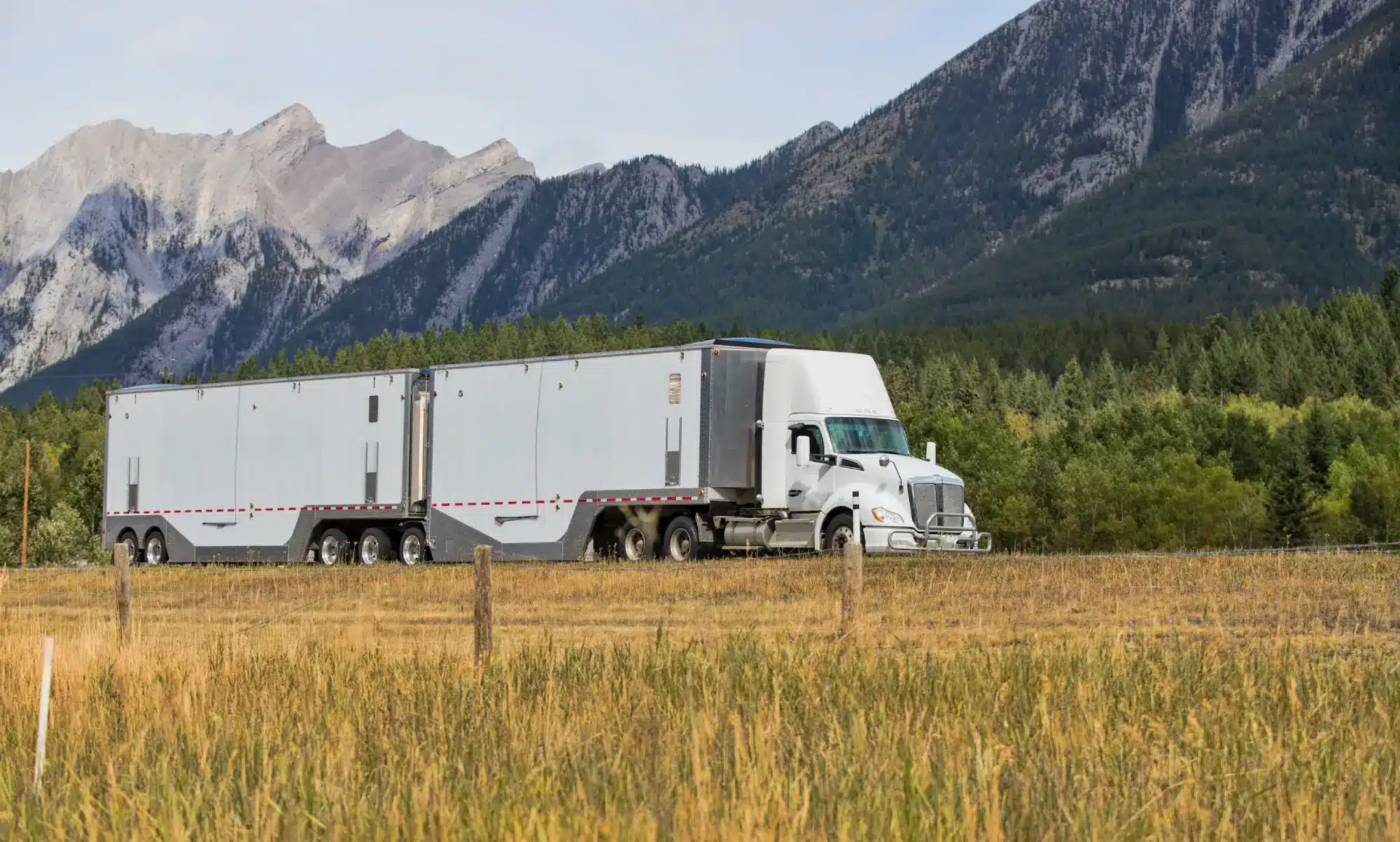
Heavy duty truck driving through a field next to mountains in Canada
On June 12, 2026, federal, provincial, and territorial transportation ministers signed a new Memorandum of Understanding (MOU) on interprovincial trucking. The agreement is designed to cut through the patchwork of provincial rules that have long created headaches for carriers, fleet managers, and drivers hauling goods across the country.
Source: This blog is based on the official news release from the Council of Ministers Responsible for Transportation and Highway Safety. Read the original news release here.
Takeaways
- Canada’s federal, provincial, and territorial governments signed a new MOU on June 12, 2026, committing to reduce regulatory barriers across the interprovincial trucking sector.
- The agreement spans 14 measures focused on aligning trucking rules, improving supply chain efficiency, and cutting red tape for carriers operating across provincial borders.
- Mandatory Entry Level Training (MELT) for commercial truck drivers will be fully implemented across all provinces and territories under this agreement.
- Oversized and overweight permit processes will be streamlined, and signage, lighting, and flag requirements for oversized loads will be standardized nationwide.
- A new web-based Canadian Trucking Regulations Hub is being developed to give drivers, dispatchers, and operators a single source for regulatory information and route planning.
- The “Driver Inc.” misclassification model remains an active government priority, and trucking businesses that rely on contractor drivers should expect continued regulatory scrutiny in this area.
What Is This MOU and Why Does It Exist?
If you’ve ever dealt with different permit requirements in Ontario versus Alberta, or trained a driver to one province’s standard only to find it doesn’t satisfy another’s, you already understand the problem this MOU is trying to fix.
Canada’s trucking industry has historically operated under a fragmented web of provincial and territorial regulations. While the rules in each jurisdiction exist for good reasons — safety, infrastructure protection, and local needs — the inconsistencies between them create real costs: time lost at borders, duplicate paperwork, and compliance confusion for drivers and dispatchers alike.
This new MOU, signed by the Council of Ministers Responsible for Transportation and Highway Safety, spans 14 measures aimed at aligning those rules and reducing trade barriers — without compromising safety standards. It builds on decades of harmonization work, including the National Safety Code MOU signed in 1987 and the Vehicle Weights and Dimensions MOU from 1988. Think of it as the next major chapter in a long-running effort to make Canada function as a single, connected freight market.
Memorandum Timeline
Here’s a quick look at the timeline leading to Canada’s 2026 Memorandum of Understanding.
- September 2024: The Committee on Internal Trade officially launched a project to reduce barriers in the trucking sector, with all provinces and territories on board.
- February 2025: At a meeting in Quebec City, ministers agreed to push toward finalizing an MOU.
- July 2025: A “Trucking Hackathon” in Toronto brought together federal, provincial, and territorial representatives alongside key industry players, including the Canadian Trucking Alliance, to brainstorm solutions and accelerate progress.
- June 2026: The MOU was officially signed.
One of the more encouraging aspects of this process is that industry had a genuine seat at the table. The Hackathon was a government exercise and a collaborative session where trucking stakeholders helped shape the direction of these changes.
The 6 Highlights That Will Affect Your Operations
1. Pan-Canadian MELT Completion
Mandatory Entry Level Training for commercial truck drivers will now be fully implemented across all provinces and territories. For a long time, MELT rollout was uneven and some provinces did not have it. Full national implementation means consistent training standards coast to coast. For fleet managers hiring drivers from different provinces, you’ll have a clearer baseline to work from, and drivers won’t be caught in gaps between jurisdictions.
2. Clearer Oversized and Overweight Permit Processes
Applying for oversize and overweight permits has traditionally been a jurisdiction-by-jurisdiction exercise, with different forms, timelines, and requirements in each province. The MOU commits to clarifying and improving these processes. For carriers running heavy hauls or wide loads across multiple provinces, this should mean less administrative friction and fewer surprises when crossing provincial lines.
3. Standardized Signage, Lighting, and Flag Requirements for Oversized Loads
New minimum standards will align the signage, lighting, and flag requirements for oversized vehicles and their escort vehicles. If you’ve ever had to reconfigure your setup depending on which province you were in, this change is aimed directly at that problem. One consistent set of requirements makes operations simpler and reduces the risk of non-compliance due to confusion between jurisdictions.
4. Long Combination Vehicle (LCV) Training Alignment
Long combination vehicles have had inconsistent training requirements from province to province. The MOU pushes for further alignment of LCV training standards. For operators running LCVs across provincial borders, this means fewer situations where a driver qualified in one province needs additional certification to operate in another.
5. Greater Harmonization of Commercial Trucking Safety Standards
The MOU includes a commitment to ongoing work toward harmonizing safety standards across the country. This is a broader, longer-term initiative but it signals a clear direction of travel. Consistent safety standards mean less guesswork for compliance teams and a more level playing field across the industry.
6. The Canadian Trucking Regulations Hub
Perhaps the most immediately practical item on the list: a new web-based Canadian Trucking Regulations Hub is being developed to serve as a single, comprehensive source of regulatory information for the industry. This should be a one-stop resource for route planning and regulatory lookups, this prevents you from hunting through multiple provincial websites to figure out what applies where. This tool has the potential to save dispatchers and owner-operators real time on a daily basis.
The “Driver Inc.” Issue
While the MOU covers the six highlights above, there’s another issue the ministers flagged as an ongoing priority: the “Driver Inc.” model.
Here’s the plain-language version: some carriers and operators have been classifying workers as independent contractors when, by the nature of their work, those workers should legally be treated as employees. This creates an uneven playing field: operators using Driver Inc. can undercut competitors on price because they’re avoiding payroll taxes, employment benefits, and other employee-related costs. It also leaves drivers without the protections they’re entitled to.
This issue was a key topic at the February 2026 Council of Ministers meeting in Vancouver, and it remains an active priority. While the MOU doesn’t finalize action on Driver Inc., expect continued regulatory attention in this area. Fleet operators and owner-operators alike should monitor developments closely, as changes to how driver classification is enforced could have significant business implications.
What’s Next and What You Should Do Now
This MOU is a meaningful step forward for the Canadian trucking industry. It reflects real commitments to reduce the friction that costs carriers time and money every day.
Here are a few practical steps to take as these changes roll out:
- Watch for the Canadian Trucking Regulations Hub launch. When it goes live, make sure your dispatch and compliance teams know about it and start using it.
- Review your MELT compliance. If you operate in a province that hasn’t yet fully implemented MELT, get ahead of the curve and ensure your drivers meet the incoming national standard.
- Stay informed on Driver Inc. developments. If your business model involves contractor drivers, keep a close eye on any regulatory changes coming out of the Council of Ministers. The direction of travel is toward stricter enforcement.
Canada’s trucking sector moves the goods that keep the country’s economy running. The fact that ministers from every province, territory, and the federal government came together to sign this agreement and that they brought industry to the table through initiatives like the Trucking Hackathon is a sign that the sector is being taken seriously at the highest levels. These changes won’t all happen at once, but the direction is clear: fewer barriers, more consistent rules, and a stronger foundation for interprovincial trade.